
AI IN FOSTER CARE EDUCATION
Solving the Hardest Education Problem in Child Welfare
Children in foster care face some of the most severe and persistent educational disruptions in the country. Frequent placement changes, delayed school records, trauma exposure, and inconsistent adult support create conditions where traditional academic interventions repeatedly fail.
At ETS, we’ve spent 30 years working inside these realities. Today, we bring artificial intelligence with heart into the mix—not to replace human tutors, but to amplify the care, encouragement, and continuity every child deserves. Our Quad-AI platform is trained to be trauma-sensitive, developmentally aware, and supportive neurodivergent learners, students with disabilities, and students with IEPs—personalizing learning while nurturing confidence, reassurance, and curiosity. This is AI built for social good, designed to bridge educational gaps for foster and Medicaid-eligible youth, no matter how complex or disrupted their educational journey.
What We’re Seeing in Foster Care Today
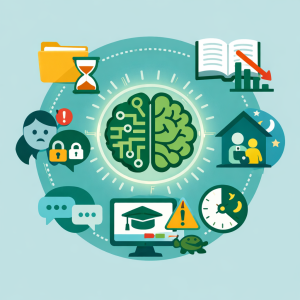
CUTTING-EDGE TRENDS DRIVING THE NEED FOR AI
Across states and counties, ETS consistently observes:
- Delayed access to school records, often weeks after placement changes
- Academic regression tied to mobility rather than ability
- High stigma around asking for help, especially among older youth
- Limited caregiver capacity, particularly outside school hours
- Inconsistent data visibility for caseworkers and agencies
Without new tools, even high-quality tutoring struggles to keep pace with the realities of foster care.

IN TRADITIONAL TUTORING MODELS
In traditional tutoring models:
- Instruction pauses while records are requested
- Learning history resets with each placement or school change
- Tutors must reassess skills manually
- Support is limited to scheduled session times
- Progress data is fragmented or delayed
For foster youth, these gaps translate into lost time, frustration, and widening academic disparities.
Why AI Matters for Foster Youth
AI OUTCOMES IN FOSTER CARE THAT ARE OTHERWISE UNATTAINABLE
It’s not able innovation, it’s about infrustructure. AI allows human tutors to focus on what matters most: relationship, trust, and instruction—while technology protects continuity and progress.
 Immediate Skill
Assessment → No waiting for transcripts or IEPs after placement changes.
 Consistent Learning Companion → Academic progress follows the child—not the school, placement, or caregiver.
 24/7 Support → Help is available when foster parents cannot provide subject-level assistance.
 Reduced Stigma → Private, patient AI-supported tutoring lowers fear of judgment and failure.
 Scalable Nationwide
Impact → Infrastructure capable of serving 100,000+ foster youth simultaneously.
Root Social Impact AI
AI DEEPLY ROOTED IN SOCIAL GOOD
Quad-AI is Social Impact AI in action. Built from three decades of serving foster youth, it goes beyond academics: it provides reassurance, motivation, and trauma-sensitive guidance at every step. Features like gamified student reports and parent dashboards empower students and caregivers, helping close learning gaps 30% faster.
For neurodivergent learners, students with disabilities, and students with IEPs, Quad-AI melds pedagogy with empathy, tailoring responses to encourage, validate, and gently guide students. Every interaction is designed with heart, ensuring that learning is not just effective—but also affirming, supportive, and inclusive.
ROOTED IN REAL SOCIAL NEED
Quad-AI isn’t an add-on—it’s a natural extension of ETS’s origins in Pittsburgh (1996), where high-dosage tutoring was first used to keep foster youth in classrooms instead of crisis systems.
What that looks like in practice:
✓ Serves ages 5–18 facing placement instability, learning gaps, and trauma
✓ Builds individualized learning paths that adapt to disrupted schooling
✓ Targets equity gaps where traditional systems fall short (i.e. only ~70% of foster youth graduate high school vs. 86% nationally)
By embedding academic support within stability-focused design, Quad-AI delivers intervention at the moment it matters most.
STUDENT-FIRST IMPACT
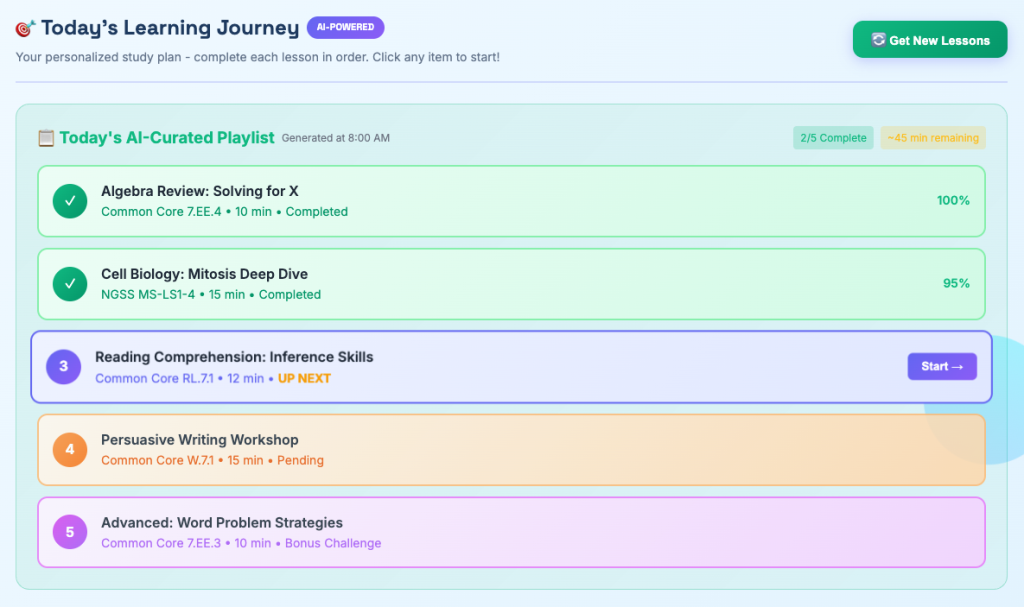
The Student Portal offers gamified progress reports that track mastery across skills and subjects while flagging emotional or behavioral barriers early. This helps reduce stress, build confidence, and keep learning on track.
Key student-facing outcomes include:
✓ Clear visibility into skill mastery and growth
✓ Early identification of emotional or behavioral learning barriers
For families, the Parent Portal provides real-time oversight without adding burden. Parents can view:
✓ Scheduling and attendance
✓ Session summaries
✓ Progress alerts
Under the hood, Quad-AI operates through a hybrid human-AI model, combining expert tutors with adaptive AI prompts. Content is generated using multiple large language models—including Claude-3, GPT-4, Gemini Pro, and Perplexity—ensuring outputs are supportive, bias-checked, and responsive to each learner rather than purely algorithmic.
BROADER SOCIAL ROI
At the student and family level, outcomes include improved academic continuity, reduced truancy and school disruptions, and clearer pathways toward long-term self-sufficiency.
At the system level, Quad-AI delivers a 129% social return on investment, driven by:
✓ Reduced family stress
✓ Improved parental mental health
✓ Increased workplace productivity
Built for scale and trust, Quad-AI is fully COPPA- and FERPA-compliant, culturally responsive by design, and deployable across all 50 states—positioning it as not just an education solution, but a durable social-impact infrastructure for Medicaid, foster care, and public-sector programs.
AI-Enhanced Foster Care Tutoring
HOW ETS IS SOLVING THE PROBLEM NOW AND AT SCALE
Introducing Quad-AI Technology! ETS’s Quad-AI platform integrates four concurrent AI providers—Claude, GPT-4, Gemini, and Perplexity—directly into live, tutor-led instruction. Each AI provider is carefully guided to respond with safety, encouragement, and reassurance, creating an experience that feels both supportive and human-centered.
Our unique approach pairs trauma-informed, human tutors with AI that adapts to each child’s learning style, pace, and emotional needs, including students with special education plans or learning disabilities. By doing so, ETS ensures continuous, individualized learning even when a child’s life is changing—filling gaps that traditional tutoring or school systems often cannot.
AI-Innovation & Foster Care Application
💡 Neural Learning Mirror: detects pre-confusion before frustration escalates—critical for trauma-impacted learners
💡 Adaptive Assessment Engine: instantly identifies skill gaps following school or placement changes
💡 AI Homework Scanner: captures assignments via camera and provides step-by-step guidance
💡 Personalized Learning Paths: adapts to each child’s cognitive style, pace, and learning history
💡Real-Time Progress Analytics: live dashboards for caregivers, caseworkers, and agencies
Platform & AI-Supported Infrastructure
ETS uses AI as academic continuity infrastructure, not as a replacement for tutors. Capabilities include:
✓ Rapid skill-gap identification when school records are delayed
✓ Adaptive monitoring following placement or school changes
✓ 24/7 homework scaffolding and academic support tools
✓ Real-time dashboards for caregivers and oversight entities
Deployment Models for Government & MCO Partners
FLEXIBLE, PROVEN AND READY TO SCALE
| 🏢 Model | 🎯 Best For |
| State Contract | State child welfare agencies requiring statewide coverage |
| MCO Partnership | Managed care organizations adding educational benefits |
| County Implementation | Counties piloting foster care tutoring |
| Federal Initiative | Nationwide rollout via HHS / ACF partnerships |